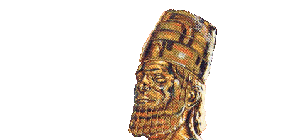
THE HEAD
OF GOLD
Babylon ~ 603 BCE to 538 BCE
From the verses 2:32-38, it is clear that Nebuchadnezzer
is the head of gold. It is understood from the verses that follow that each
portion of the image represents a kingdom which follows the one before. At the
time this was written, Babylon was the dominant world power.
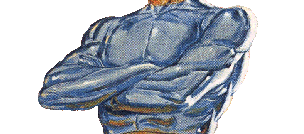
THE
CHEST AND ARMS OF SILVER
Media & Persia ~ 538 BCE to
331 BCE
2:39 And after you shall arise another
kingdom inferior to you;
Beginning in chapter Daniel 5, we understand that Belshazzar
is the son of Nebuchadnezzer. In verses 30 & 31, we learn that when Belshazzar
died, the kingdom was taken over by Darius the Mede. From there, the kingdom
was split between Media and Persia.
Later in Daniel 11:2-4 we read more about the fall
of Media and Persia to Greece.
Daniel 11:2 And now will I show you the
truth. Behold, there shall stand up yet three kings in Persia; and the fourth
shall be far richer than they all: and when he has become strong through his
riches, he shall stir up all against the realm of Greece. 3 And a mighty king
shall stand up, that shall rule with great dominion, and do according to his
will. 4 And when he shall stand up, his kingdom shall be broken, and shall be
divided toward the four winds of heaven, but not to his posterity, nor
according to his dominion with which he ruled; for his kingdom shall be plucked
up, even for others besides these.
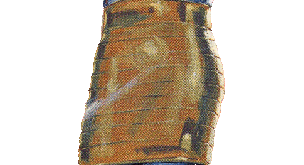
THE
BELLY OF BRONZE
Grecian Empire 331 BCE to 168 BCE
2:39 ... and another third kingdom of
bronze, which shall bear rule over all the earth.
We discover who is the successor to Media/Persia in
chapter 8:20
The ram which you saw, that had the two
horns, they are the kings of Media and Persia. 21 And the rough he-goat is the
king of Greece: and the great horn that is between his eyes is the first
king.
Greece defeated the empire of Media and Persia
approx. 331bce.
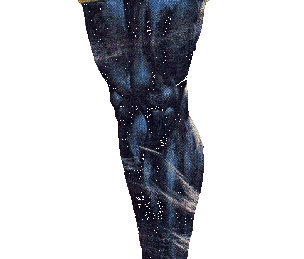
THE LEGS
OF IRON
Roman Empire 168 BCE to 476
AD
40 And the fourth kingdom shall be strong as
iron, because iron breaks in pieces and subdues all things; and as iron that
crushes all these, shall it break in pieces and crush.
From here one has only to
research any reliable history reference book or
encyclopedia to find that the Grecian Empire was
defeated by the Roman empire ~187 BCE, in the Greco-Roman wars. Rome then
continued to be the dominant world leader until falling to the barbarians ~ 470
AD. Remember that Rome was the occupying force even in Jerusalem at the time of
the Messiah.
THE FEET
OF IRON AND CLAY
Holy Roman Empire ~
314 AD
41 And whereas you saw the feet and toes,
part of potter's clay, and part of iron, it shall be a divided kingdom; but
there shall be in it of the strength of the iron, because you saw the iron
mixed with miry clay.
This is a list of points describing the kingdom in
place at the end of the age, as scripture has described.
- This is an empire that will be partially
Roman.
- It must also be a continuation of the previous Roman empire
- It must be a global empire.
- It must be one that is in power
today.
- It must have the dual quality of being
spiritual and political.
- It must be a divided kingdom &
partially broken
Compare this to a list of points describing the Holy
Roman Empire / Roman Catholic Church
- The Roman Catholic church is the only surviving portion of the Roman
empire.
- It is in fact a continuation of the "Holy Roman Empire", which began
in 314 AD.
- It is obviously a global empire, the largest of its kind,
- and is in power today.
- The Holy Roman Empire co-existed alongside the Roman Empire until
Rome fell to the barbarians.
- Originally a political empire, it was mixed with the "miry clay" when
Constantine made Catholicism the official religion of the Roman Empire, which
was broken in 476.
However, long before then, the bulk of the
power had been transferred to the Holy Roman Empire, and the Pope had long been
the seat of authority.
42 And as the toes of the feet were part of
iron, and part of clay, so the kingdom shall be partly strong, and partly
broken. 43 And whereas you saw the iron mixed with miry clay, they shall mingle
themsleves with the seed of men; but they shall not cling one to another, even
as iron does not mingle with clay.
This passage plainly states that the clay
represents "the seed of men"
Seed, in
prophecy represents "The Word". Read the parable of the sower, and the
interpretation in the book of Matthew 13:1-23, Mark 4:1-20, Luke 8:4-8. Each of
these plainly illustrate that "the seed" is in fact "the Word".
We therefore
have in the final days, a kingdom, of Rome which stands on "The Word" of
men. Rome>>Holy Roman Empire >> Roman Catholic
Church.
Remember that "the Word" also represents "the way, the truth and the
life" and indeed the Messiah himself.
Now since,
the RCC represents themselves as "the way", and there can be no more
complete
fullfillment of this prophecy than
this.
The
fall of babylon (or tower thereof) was brought about by the confusion of
languages.
The fall of the image was brought about by the
stone that was made not with hands
The stone is
the name. (he is the stone which was rejected by you
builders)
also read Acts ch. 4
and there
are other ways of determining the symbol as well.
The temple
was built as a dwelling place for the name,
The holy
place is the dwelling place of the name.
II Thess
2
Now then, for as many languages as there are,
there are just as many different names which are
worshipped.
This creates confusion in worship (and
prophecy) and therefor establishes that this is the Babylonian Kingdom
(actually part of)
as they are attempting to create thier own way
into heaven. >> the Roman way into heaven would interpret directly into
"iron mixed with clay",
and as feet,
supporting the entire Babylonian kingdom; this being the latter days we are in
now, and
the RCC is the only remaining apparant
incarnation of the image. Although all the rest are
still with
us, spiritually in one way or another. the RCC is the current physical
incarnation.
- The seed is the word.
- His name is called the word.
- Many shall come in my name.
Between 509 B.C. and 476 A.D. Rome was successively the capital of the
republic of the same name and of the Roman Empire. ... The city became the Holy
See about 42 A.D. From the downfall of the Roman Empire to the formation, in
June, 1947, of the Italian republic, Rome was, at various times, capital of the
Holy Roman Empire, the Papal States, and the kingdom of Italy.
Funk & Wagnalls Standard Reference Encyclopedia 1964, p.
7636
Constantine ... overcame all rivals and reunited the western Empire
under his rule. In 314 the defeat of Licinius, emperor in the east, made
Constantine sole ruler of the Roman world. ... Constantine, adopting
[Christianity] as his own religion, made it also the official religion of the
Roman Empire, an event of far-reaching significance.
Funk & Wagnalls Standard Reference Encyclopedia 1964,
p.7647
The history of Rome then merged with that of the papacy, the Holy Roman
Empire, the Papal States, and Italy.
Funk &
Wagnalls Standard Reference Encyclopedia 1964,p.7648
The term catholic (Gr. Katholikos, "universal" from kath'holou, "in
general") is found for the first time in the letter of St. Ignatious to the
smyrnaeans (about 110), and later appeared in Clement of Alexandria's Stromata.
Its technical use seems to ahve been established by the beginning of the 3rd
century, The formal principle of the Catholic church was expressed by Vincent
of Lerins (about 434) as follows: "That which has been believed everywhere,
always, and by all. This is what is truly and properly catholic."
Funk & Wagnalls Standard Reference Encyclopedia 1964, p.
1866
The papacy, which arose on the ruins of the Roman empire, differed from
all previous forms of Roman power in that it was an ecclesiastical despotism
claiming universal dominion over both spiritual and temporal affairs,
especially the former. It was a union of church and state, ferquently with the
church dominant.
Bible Readings for the Home
1914, 1935, 1942, 1958, and 1963 by the Review and Herald Publishing
Association London, England. Library of Congress Catalog Card Number 63-12806
p. 170
"Whatever Roman elements the barbarians and Arians left ..[came] under
the protection of the Bishop of Rome, who was the chief person there after the
Emperor's disappearance. ... the roman church in this way privily pushed itself
into the place of the Roman World-Empire, of which it is the actual
continuation; the empire has not perished, but has only undergone a
transformation. ... That is no mere ‘clever remark', but the recognition
of the true state of the matter historically and the most appropriate and
fruitful way of describing the character of this church. It still governs the
nations. ... It is a political creation, as imposing as a World-Empire, because
it is the continuation of the Roman Empire. The Pope, who calls himself "King"
and "Pontifex Maximus," is Caesars's successor."
Adolf Harnack, What is Christianity? New York: Charles
Scribner's Sons, 1915, Preface p. vi
|